A resume without work experience: writing from real evidence
Turn projects, education, internships, volunteering, and demonstrable skills into a clear, honest resume when you have no formal employment history.
- Resume writing guides
- Resume without experience
- First resume
- Student resume
- Projects
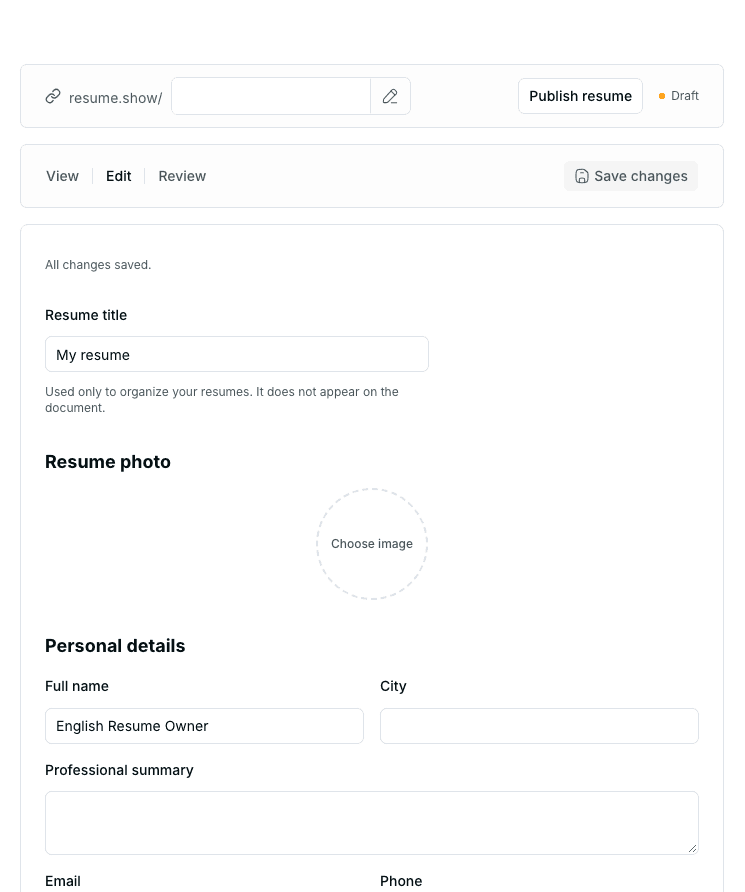
No formal employment history does not mean you have nothing to write. A course project, personal exercise, short internship, volunteer activity, or genuine responsibility in a family business can show your work and skills. Every item must be real, relevant, and explainable.
At this stage, the goal is not filling a page. Help readers quickly connect your abilities to the target role. This guide explains how to find, organize, and describe the evidence you already have.
1. Choose a target role first
Choose a specific title, such as "Data analysis intern," "Junior frontend developer," or "Content assistant." A resume aimed at every possible role rarely highlights the right evidence.
Read several real advertisements for that role and record recurring requirements:
- Main responsibilities
- Essential tools and skills
- Expected outputs
- Requirements you genuinely meet and can demonstrate
Use advertisement terminology only when it matches actual experience. A keyword without evidence does not replace experience.
2. Build an evidence bank
Before choosing a template, collect possible experiences in a rough list. Polished wording can wait. For each, record the problem, your action, tools used, and observable output.
Sources may include:
- University or final-course projects
- Completed or demonstrable personal projects
- Internships, even short ones
- Volunteering for an association, event, or nonprofit
- Genuine work in a family business
- Course exercises you personalized and completed
- Operational responsibilities in student or professional groups
Enrolling in a course or naming an unpracticed skill is not enough. A small, explainable output is more useful than a long list of adjectives.
3. Select by relevance
Not everything belongs in the resume. Ask three questions about each experience:
- Does it demonstrate a need of the target role?
- Can I explain my own contribution precisely?
- Do I remember the output, tools, or method?
If most answers are no, give that item little space. When an experience is indirectly related but demonstrates planning, writing, analysis, or coordination, state the transferable connection explicitly.
4. Put your strongest evidence first
A useful starting order is:
- Contact details and target title
- Short professional summary
- Relevant, demonstrable skills
- Projects, internships, or related activity
- Education
- Relevant courses and certifications
- Languages or additional activities, where relevant
This is not fixed. Put projects above education if they are stronger. A relevant internship may fit under "Relevant experience." Make headings reflect reality; do not describe a project as full-time employment.
5. Write a short, specific summary
Generic claims such as "hardworking and motivated" need supporting evidence. Combine the target role, skill area, and one or two principal examples instead.
Suggested pattern:
[Student/graduate/career changer] in [field] with practical experience in [project or activity type]. Familiar with [two or three relevant tools], with examples of [observable output]. Interested in [target role] to apply [relevant ability].
Replace brackets with facts. Remove the portfolio claim if you have no examples; do not invent evidence.
6. Turn experiences into verifiable bullets
Use:
Action + context or problem + output + tool or method
Instead of "Responsible for website design," explain the particular pages or features, their purpose, and tools. Include defensible figures when available; otherwise describe a deliverable or scope without inventing numbers.
Fill-in examples:
- Designed and implemented [page or feature] for [academic/personal project] using [tool], delivering [observable output]
- Cleaned and analyzed [data type] for [project name or subject], presenting findings in [report/dashboard/presentation]
- Planned content for [event or association], coordinated [groups], and prepared [specific output]
"Helped" can obscure your contribution. Name your exact part in a team without claiming the whole result.
7. Example resume without employment history
Example disclosure: This editorial template contains placeholders, not a real person, university, organization, or employer. It promises no hiring outcome. Replace or remove every bracketed item with your own evidence.
[Full name]
[Target title, such as Data analysis intern]
[City] | [Phone] | [Professional email] | [Relevant portfolio or profile]
Professional summary
[Student or graduate in a relevant field] with practical experience in [project type]. Familiar with [tool one] and [tool two], with examples of [output type]. Applying for [target role] to use [relevant skill].
Skills
- [Skill actually used in a project]
- [Tool relevant to the role]
- [Language with an accurate, defensible level]
Relevant projects
[Project name] — [Personal/academic/course project]
[Actual dates]
- [Your action] for [specific problem or goal] using [tool]
- Prepared [observable output] covering [actual scope or components]
- Documented [method, decision, or finding] in [report, repository, or presentation, if available]
Related activities
[Actual activity title] — [Association or organization]
[Actual dates]
- Coordinated [specific work] for [event or activity], delivering [output]
- Worked with [actual team] on [your responsibility]
Education
[Field or program] — [Institution]
[Start and end dates or "Currently studying"]
- Related courses or projects: [Relevant items only]
Courses
- [Completed course] — [Provider], [Year]
Check every line: "Could I explain the work and my contribution if asked in an interview?" If not, make it more precise or remove it.
8. What if you still lack evidence?
Do not compensate with invented history. Define a small, bounded project related to the target role, with an observable output and clear scope.
For example:
- Content: produce a short calendar and sample copy for a hypothetical business, explicitly labeled hypothetical.
- Data analysis: use public data and document cleaning steps, questions, and findings.
- Interface design: redesign a limited flow and explain the problem, decisions, and constraints.
- Software development: implement, document, and demonstrate one small feature.
Add the project only after doing the work. You can discuss ongoing learning, but it does not replace a completed output.
9. Common mistakes
- One generic resume for unrelated roles
- Many skills without examples of use
- Projects or volunteering described as formal employment
- Approximate figures or unexplained achievements
- A long summary filled with generic adjectives
- Unnecessary personal information
- Hiding the strongest project at the bottom
- Sending without checking spelling, links, or filename
See common resume mistakes for more detail.
10. Final checklist
- The target title is specific.
- Each important skill has at least one real supporting experience.
- Projects, internships, and activities are honestly labeled.
- Your contribution to teamwork is clear.
- Dates and tool names are accurate.
- No figures, certifications, or results are invented.
- Portfolio links open and contain relevant work.
- Spelling, readability, and consistency have been checked.
Use resume review for a step-by-step review.
Next step
Build your evidence bank and select related experiences. Browse resume examples for alternative section arrangements, then organize your actual information in the ResumeYek resume builder.
No template guarantees employment. The value of this process is presenting real experience clearly, relevantly, and in a way that can be checked.
Related articles
Student resumes: education, projects, and internships
Present education, academic projects, student activities, internships, and real skills in a clear student resume tailored to your opportunity.
Preparing a resume PDF for import and troubleshooting
Check PDF text, passwords, scans, and layout before importing, then compare the structured draft with your original resume section by section.
Translating a resume into English: a meaning and review checklist
Check job titles, dates, official names, verb tense, terminology, and layout before and after translating your resume.